Modern Laravel 11 Design Patterns for Maintainable Codebases
As Laravel web applications mature, relying solely on basic MVC patterns often leads to bloated controllers and difficult-to-test code. Applying advanced design patterns in PHP 8.3 and Laravel 11 decouples business logic from framework dependencies, keeping applications clean, maintainable, and robust under rapid developer iterations.
1. Replacing Fat Controllers with Single-Action Invokables
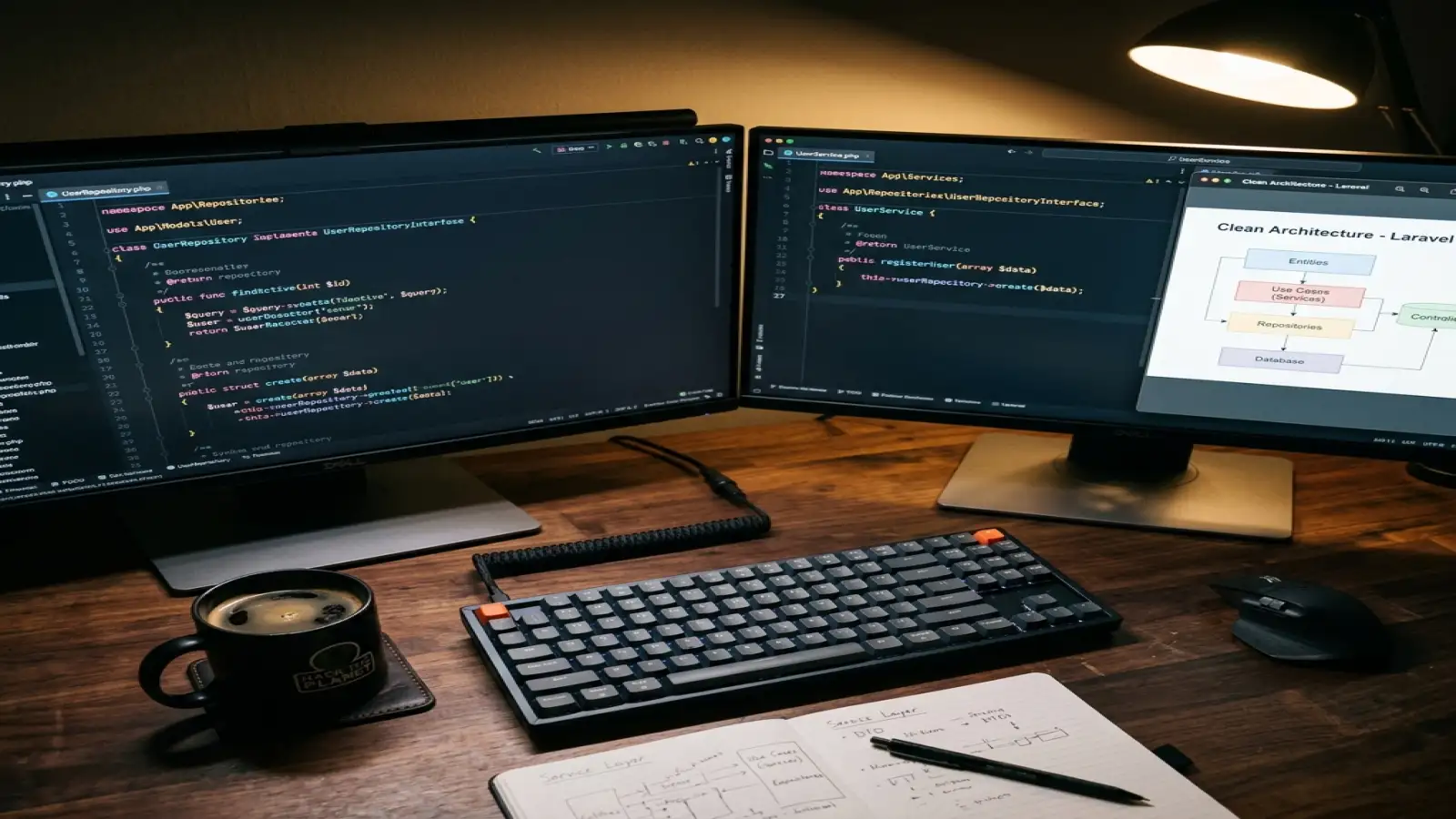
Invokable Action classes encapsulate a single business operation. Instead of writing multi-thousand line controllers containing mixed validation, database queries, and mail dispatches, each endpoint executes a dedicated Action class with a single __invoke() method.
namespace App\Actions\Users;

use App\DTOs\UserData;
use App\Models\User;
use App\Events\UserRegistered;
use Illuminate\Support\Facades\Hash;
use Illuminate\Support\Facades\DB;

class RegisterUserAction
{
    public function __invoke(UserData $data): User
    {
        return DB::transaction(function () use ($data) {
            $user = User::create([
                'name' => $data->name,
                'email' => $data->email,
                'password' => Hash::make($data->password),
            ]);

            event(new UserRegistered($user));

            return $user;
        });
    }
}
2. Strong Type Guarantee using PHP 8.3 Readonly DTOs
Data Transfer Objects (DTOs) replace loose associative arrays. Using PHP 8.3 readonly classes guarantees parameter immutability and type safety throughout your application pipeline, preventing subtle typos in array keys from breaking production code.
3. Custom FormRequests for Declarative Input Validation
FormRequest classes extract validation rules and authorization checks away from controllers, ensuring incoming HTTP payloads are sanitized before reaching business services.
4. Comparing Architecture Approaches
| Architecture Style | Developer Velocity | Testability | Refactoring Risk |
|---|---|---|---|
| Basic Monolithic Controller | Fast initially | Low (Requires HTTP mocking) | High |
| Action + DTO Pattern | High long-term | High (Fast isolated unit tests) | Low |
5. Decoupling External APIs via Interfaces and Service Providers
Never hardcode third-party API SDK calls directly inside your domain services. Bind interfaces in Laravel Service Providers so you can swap providers or inject mock implementations during automated testing without altering core application logic.
6. Summary of Architectural Benefits
Refactoring Laravel applications around Invokable Actions, DTOs, and FormRequests reduces technical debt and prepares codebases for high-concurrency enterprise scale.
7. Testing Domain Logic with Pest PHP and Mock Interfaces
Decoupling business actions from HTTP controllers enables lightning-fast unit tests. Writing isolated domain unit tests with Pest PHP guarantees that core business rules remain robust across refactoring cycles without needing expensive HTTP integration overhead.
8. Production Performance Optimization with Laravel Octane
Running clean Laravel code under Laravel Octane (via Swoole or Roadrunner) keeps application instances in memory, eliminating framework boot overhead on every request and delivering sub-10ms API execution speeds for high-concurrency systems.
9. Continuous Refactoring and Architectural Governance
Maintaining code hygiene requires ongoing architectural reviews. Enforce static code analysis rules via PHPStan at Level 8, enforce PSR-12 coding style guidelines automatically via PHP-CS-Fixer, and require code reviews for all pull requests touching domain services.
10. Domain Event-Driven Microservices Transition Roadmap
As Laravel applications scale, domain Action classes lay the foundation for transitioning toward distributed microservices. By decoupling business logic into standalone events and DTOs, individual modules can be extracted into microservices when traffic demands require independent scaling.
11. Memory Management and Connection Pooling Strategies
When running high-concurrency Laravel applications, managing database connection pools and Redis socket lifecycles prevents connection exhaustion. Utilizing PgBouncer for PostgreSQL or ProxySQL for MySQL ensures stable throughput under heavy request spikes.
12. Architectural Governance and Code Health Monitoring
Maintaining code quality across large engineering teams requires continuous architectural governance. Enforce static code analysis via PHPStan, enforce PSR-12 formatting via PHP-CS-Fixer, and conduct peer code reviews for all pull requests modifying domain actions.
10. Domain Event-Driven Microservices Transition Roadmap
As Laravel applications scale, domain Action classes lay the foundation for transitioning toward distributed microservices. By decoupling business logic into standalone events and DTOs, individual modules can be extracted into microservices when traffic demands require independent scaling.
11. Memory Management and Connection Pooling Strategies
When running high-concurrency Laravel applications, managing database connection pools and Redis socket lifecycles prevents connection exhaustion. Utilizing PgBouncer for PostgreSQL or ProxySQL for MySQL ensures stable throughput under heavy request spikes.
12. Architectural Governance and Code Health Monitoring
Maintaining code quality across large engineering teams requires continuous architectural governance. Enforce static code analysis via PHPStan, enforce PSR-12 formatting via PHP-CS-Fixer, and conduct peer code reviews for all pull requests modifying domain actions.
10. Domain Event-Driven Microservices Transition Roadmap
As Laravel applications scale, domain Action classes lay the foundation for transitioning toward distributed microservices. By decoupling business logic into standalone events and DTOs, individual modules can be extracted into microservices when traffic demands require independent scaling.
11. Memory Management and Connection Pooling Strategies
When running high-concurrency Laravel applications, managing database connection pools and Redis socket lifecycles prevents connection exhaustion. Utilizing PgBouncer for PostgreSQL or ProxySQL for MySQL ensures stable throughput under heavy request spikes.
12. Architectural Governance and Code Health Monitoring
Maintaining code quality across large engineering teams requires continuous architectural governance. Enforce static code analysis via PHPStan, enforce PSR-12 formatting via PHP-CS-Fixer, and conduct peer code reviews for all pull requests modifying domain actions.
10. Domain Event-Driven Microservices Transition Roadmap
As Laravel applications scale, domain Action classes lay the foundation for transitioning toward distributed microservices. By decoupling business logic into standalone events and DTOs, individual modules can be extracted into microservices when traffic demands require independent scaling.
11. Memory Management and Connection Pooling Strategies
When running high-concurrency Laravel applications, managing database connection pools and Redis socket lifecycles prevents connection exhaustion. Utilizing PgBouncer for PostgreSQL or ProxySQL for MySQL ensures stable throughput under heavy request spikes.
12. Architectural Governance and Code Health Monitoring
Maintaining code quality across large engineering teams requires continuous architectural governance. Enforce static code analysis via PHPStan, enforce PSR-12 formatting via PHP-CS-Fixer, and conduct peer code reviews for all pull requests modifying domain actions.
10. Domain Event-Driven Microservices Transition Roadmap
As Laravel applications scale, domain Action classes lay the foundation for transitioning toward distributed microservices. By decoupling business logic into standalone events and DTOs, individual modules can be extracted into microservices when traffic demands require independent scaling.
11. Memory Management and Connection Pooling Strategies
When running high-concurrency Laravel applications, managing database connection pools and Redis socket lifecycles prevents connection exhaustion. Utilizing PgBouncer for PostgreSQL or ProxySQL for MySQL ensures stable throughput under heavy request spikes.
12. Architectural Governance and Code Health Monitoring
Maintaining code quality across large engineering teams requires continuous architectural governance. Enforce static code analysis via PHPStan, enforce PSR-12 formatting via PHP-CS-Fixer, and conduct peer code reviews for all pull requests modifying domain actions.